
Sex Offender Checks in Roberts County
The Texas Public Sex Offender Registry, managed by the Texas Department of Public Safety Crime Records Division, is the first public search channel for Roberts County. It accepts name and location searches and can filter by county. The Roberts County sheriff performs local registration functions, but the county publishes no stand-alone list, map, notification service, or registry office page. That makes the DPS record the practical starting point, not the last word.
Prepare a full name, an address or the Miami ZIP code, and a reasonable area to search. Name spelling and aliases may affect results. For place searches, read the result details rather than relying on a pin. DPS states that its display is based on registration data and directs users to verify concerns with the law enforcement agency shown on the profile. Immediate danger belongs with 911. A nonurgent question about a Roberts County listing can go to the sheriff at (806) 868-3121.
Why Roberts County Uses the Registry
Many county websites maintain a local registry page. Roberts County does not. That absence does not mean registration is optional or that no records exist. Texas Code of Criminal Procedure Chapter 62 creates the state system and assigns duties to local law enforcement. The official Texas Sex Offender Registration Program explains that statewide framework. The public DPS search gathers those records into one interface while Roberts County carries out local registration and verification tasks.
The split matters when data seems stale. DPS publishes the central record, yet the profile identifies the registering agency that can check a recent address report or status question. The sheriff is not a second public database. It is the local verification point. For general county criminal records outside this narrow registry purpose, use the broader Roberts County criminal history channels.
DPS also publishes the registry landing page and its notices. The captured interface below shows why the state site remains the main Roberts County route.
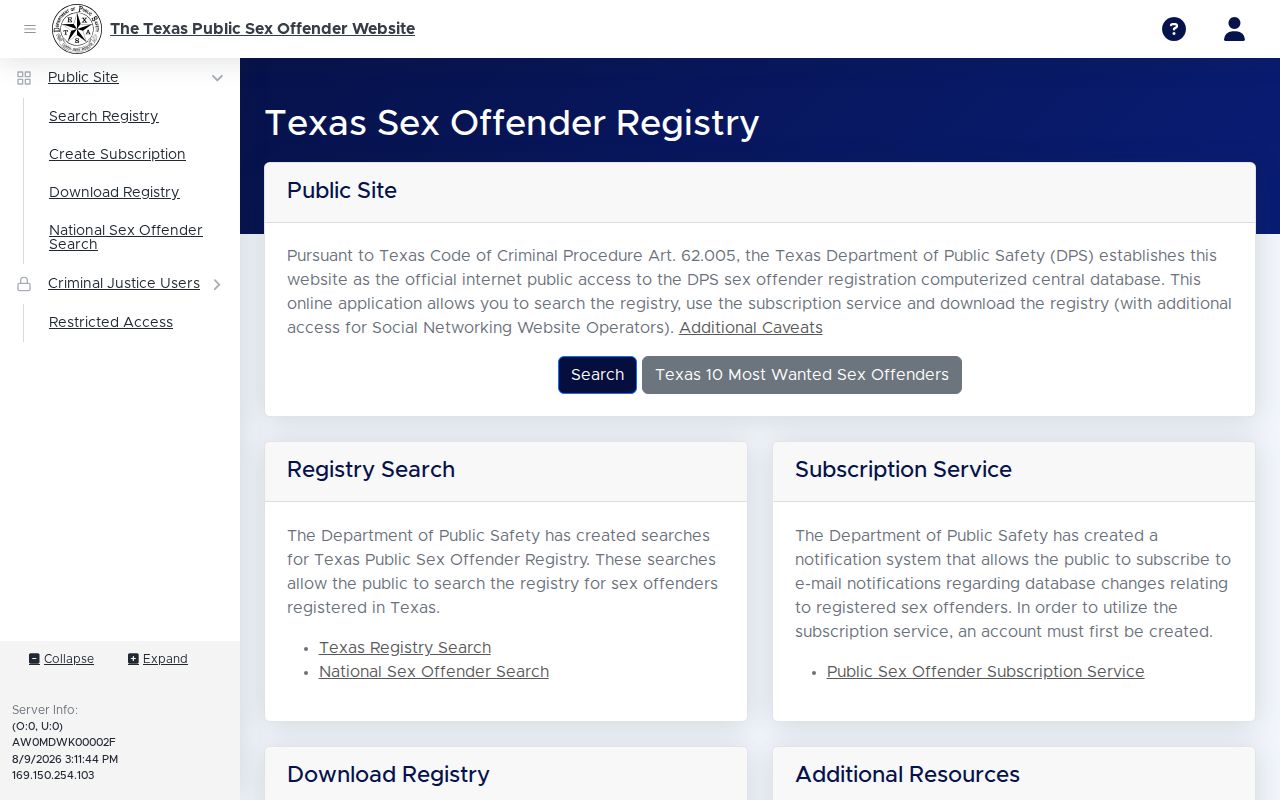
The notices should be read before using any result because they explain limits on accuracy and acceptable use.
How to Search the Texas Public Sex Offender Registry
The DPS form supports two useful paths. A name search works when the person is known. A location search works for Roberts County community awareness. Run more than one query if spelling, an alias, or an address is uncertain, and keep the filters broad enough to avoid hiding a relevant result.
- Open the official DPS registry and read the conditions and accuracy notice.
- Choose the name or geographic path. Enter a name, or use Miami, ZIP 79059, an address, or Roberts County.
- Set the available radius when using a location, then run the search and compare result details.
- Open the profile, check the registering agency and verification data, and contact that agency when a current fact needs confirmation.
| Search control | Type | Required | Use in Roberts County |
|---|---|---|---|
| Search type | Tab or control | Varies | Switches between name and location paths |
| Last Name / First Name | Text | Name route | Spelling and aliases can change matches |
| Address / City | Text | Location route | Miami may be entered |
| County | Dropdown | Optional filter | Select Roberts |
| ZIP Code | Text | Optional filter | Use 79059 for the Miami area |
| Radius | Dropdown | Location search | Uses the interface’s distance choices |
| Search / Clear | Buttons | Submit or reset | Runs a query or clears the form |
The official DPS search form displays these Roberts County registry controls.
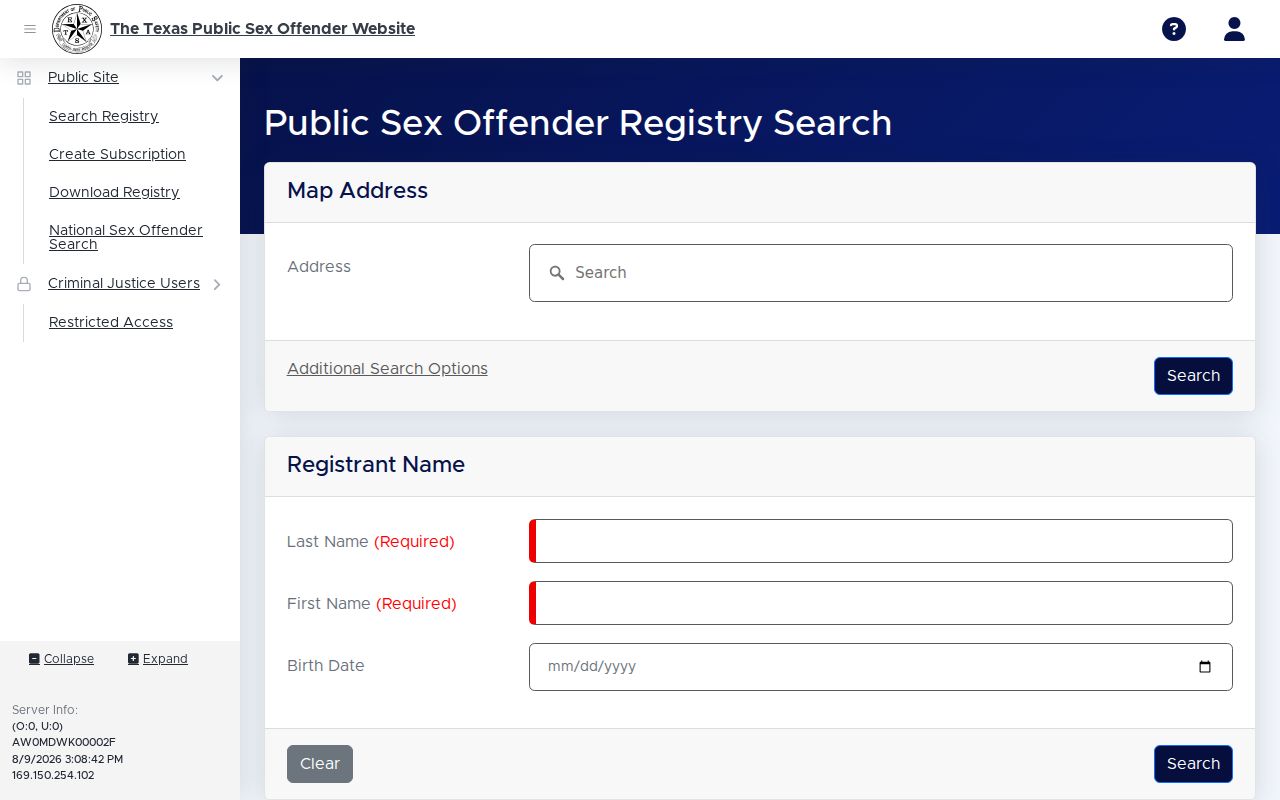
The screen is a search tool, not proof that a pin marks a person’s precise location at the moment it is viewed.
Reading Roberts County Registry Map Pins
Miami and ZIP 79059 give a practical starting point for a place search, but Roberts County covers a broad rural area. A radius can cross town limits and may include a registered address, a general location, or a record whose position should be checked with the agency. The map does not establish that someone is present at that spot now. Nor does proximity alone state a person’s current risk or conduct.
Open the full profile. Compare the listed location, status, registering agency, and verification details. If the result affects a personal or family safety plan, call the listed law enforcement agency rather than visiting an address. No verified Miami or Roberts County residence-distance ordinance was found in official sources. Chapter 62 itself is not a blanket statewide distance rule, though a valid local law or supervision condition can create a separate restriction.
Note: A wide Roberts County radius can return places beyond Miami, so read jurisdiction and agency fields before drawing a conclusion.
Inside a Registry Profile
A public Texas profile combines identity details, the reportable offense, registration status, and the agency responsible for the record. The exact fields vary. Some information is held back by law. Article 62.005 excludes items such as Social Security numbers, driver license data, phone numbers, online identifiers, victim-identifying data, and other specified fields. Texas Government Code Chapter 411 supplies related criminal-history dissemination limits. A blank public field may reflect confidentiality rather than a missed report.
| Name and aliases | Legal name and other names used to help distinguish identity. |
|---|---|
| Photo and description | Photograph plus sex, race, age or birth information, height, weight, eye color, and hair color where displayed. |
| Address or location | The public registered address or location data, subject to the record and legal display rules. |
| Offense details | Offense description or statute and conviction or adjudication date, with victim category when lawfully shown. |
| Risk information | Texas risk-assessment label when present, not a federal duration tier. |
| Registration status | Status, verification or reporting data, and the registering law enforcement agency. |
| Other public fields | Vehicle, institution, or employment-related fields only where Chapter 62 makes them public. |
Read the offense date, registration status, and verification details together. One field alone cannot establish a current duty, physical presence, or risk assessment.
Roberts County Registry Versus NSOPW
The DPS registry is best for a Texas-centered Roberts County search and Texas registration detail. The U.S. Department of Justice National Sex Offender Public Website adds a nationwide search across participating jurisdictions. It is useful when a person may have moved across a state line or when the known place is outside Texas. NSOPW does not replace the source jurisdiction’s record.
Search both systems when the facts cross borders. Then return to DPS for Texas detail and to the registering agency for current verification. A mismatch can reflect timing, search limits, or the public rules of the source jurisdiction. It should not be resolved through confrontation.
The federal NSOPW interface shows the nationwide search layer.
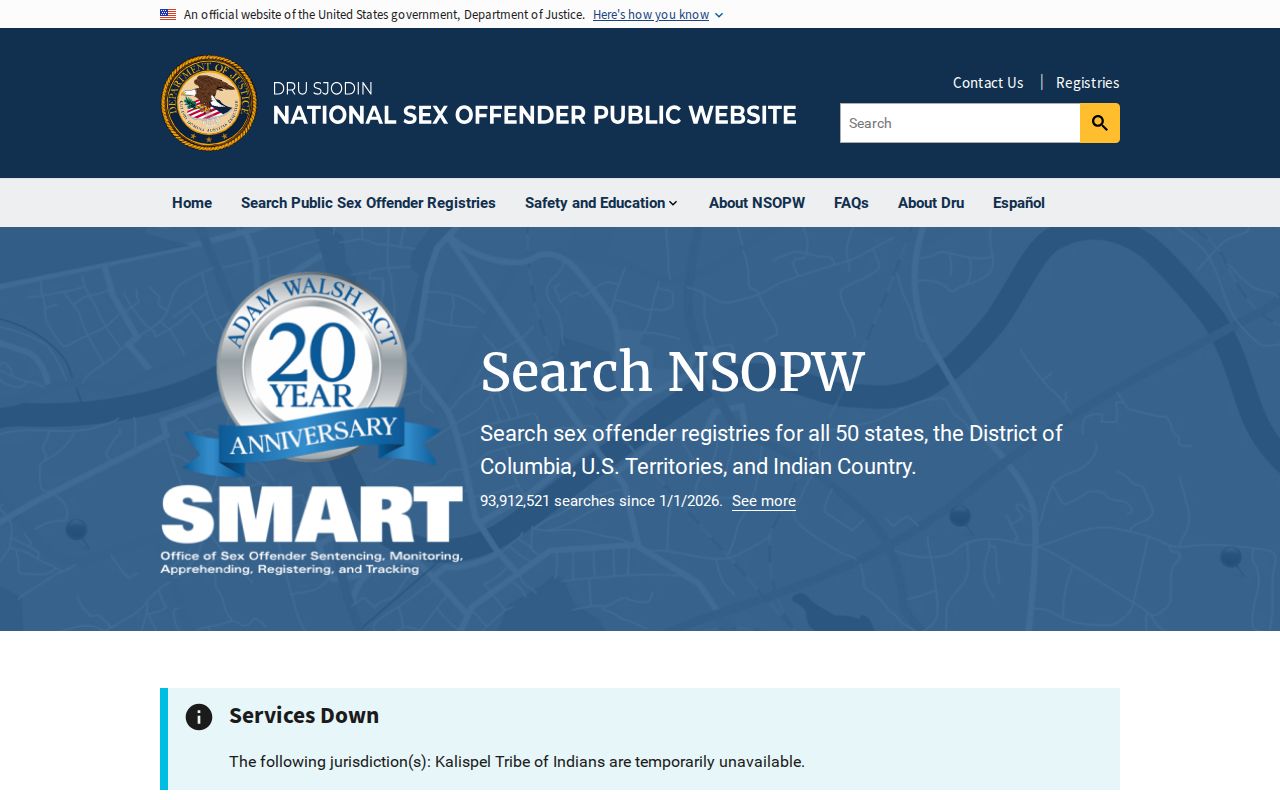
This broader tool is a supplement, while Texas DPS and local law enforcement remain the sources for a Roberts County listing.
Texas Registration Levels and Requirements
Texas does not use a simple Tier I, II, and III chart to set every registration term. Duration depends on the reportable offense and statutory history. The term is lifetime for specified categories or a post-supervision period, commonly ten years, for reportable convictions and adjudications outside the lifetime groups. Risk labels describe assessed danger. They are not duration tiers.
| Texas category | Meaning | Duration or verification |
|---|---|---|
| Level 1 / low | Assessed as low danger and not likely to continue criminal sexual conduct | Read duration from the offense and Chapter 62; ordinary verification is generally annual |
| Level 2 / moderate | Moderate danger and may continue such conduct | Risk label alone does not set the term |
| Level 3 / high | Serious danger and expected to continue such conduct | May trigger added community notice; duration remains offense-based |
| Civil Commitment | Court-designated sexually violent predator in intensive supervision and treatment | Follow the specific court and program requirements |
| Two or more sexually violent dispositions | Statutory history can raise verification frequency | Generally at least once every 90 days |
| Other registrants | Subject to their governing category and instructions | Ordinarily annual, within 30 days before or after the birthday |
For a Level 3 record, DPS describes notice in English and Spanish within one mile in an unsubdivided area or three blocks in a subdivided area. Authorities may use meetings, print notices, handbills, posted notices, or websites as permitted.
Roberts County Offender Verification Duties
Chapter 62 governs initial registration, address and status changes, recurring verification, and the public database. Article 62.058 addresses reporting changes. Article 62.056 supplies the law enforcement verification framework. A Roberts County registrant follows the category, schedule, and directions that apply to the actual record. The public should not try to calculate compliance from one old screen alone.
A concern about a changed address or a missed verification belongs with the registering agency named in the profile. Roberts County residents can also call the sheriff’s nonemergency number. Give the public profile information and the reason for concern. Do not conduct surveillance or attempt to confirm the address in person. Article 62.102 makes failure to comply with registration requirements a separate criminal offense, but law enforcement determines whether facts support an investigation.
Note: A registry status is separate from a new court case, and a public profile does not by itself show every current court event.
Roberts County Registration Duration
Article 62.101 supplies the duration rules. Some reportable convictions or adjudications require lifetime registration. Other covered records commonly require a ten-year period measured after release from confinement, parole, or community supervision under the governing statute. The right answer depends on the precise offense, age and adjudication facts, later history, and the text now in force.
Do not infer the end date from a low, moderate, or high risk label. Those labels serve a different purpose. The displayed offense and history must be matched to Chapter 62, and the registering agency can confirm the active record. Roberts County has no published local removal form or separate process to substitute for state law. A question about a person’s own duty calls for official confirmation and, when needed, legal advice based on the full judgment.
Community Notification and Lawful Use
Registry information supports personal, family, and community safety. It can help residents understand a notice, check an area, or identify which agency holds a current registration record. It does not permit threats, injury, stalking, harassment, or vigilantism. Never use a map to visit or confront a registrant or the people at an address. Call 911 for an immediate threat and use the sheriff’s nonemergency channel for a concern that is not urgent.
Misuse is unlawful: Texas Code of Criminal Procedure Chapter 62 and DPS registry notices prohibit using registry information to injure, harass, or commit a crime. Article 62.102 separately criminalizes a registrant’s failure to comply.
Accuracy also has limits. A profile may be changed after a report reaches the agency, and a map cannot prove present location or future conduct. Use public data to plan safe steps. Let law enforcement verify compliance.