
Roberts County Arrest History
Roberts County arrest history begins with the agency that took a person into custody. The official local law-enforcement route is the Roberts County Sheriff's Office. No separate Miami police records unit has been documented. State troopers or another authorized agency may also make an arrest, but the creating agency keeps its own incident and arrest report. Intake then creates a distinct custody record with a booking identifier, fingerprints, alleged charges, bond data, property information, and release or transfer details.
The county does not publish a booking search, arrest blotter, named jail page, mobile app, or public warrant lookup. The Texas Crime Information Center serves law enforcement and is not a public warrant portal. Call the sheriff first and ask where the person was taken. If an outside jail received the person, that housing agency becomes the source for current custody and release facts. The clerk becomes relevant when prosecutors file a cause. A DPS result serves a different statewide purpose and is not a live Roberts County arrest log.
Roberts County Sheriff Arrest Channel
The Roberts County Sheriff's Office publishes one verified nonemergency and business number, (806) 868-3121. Its mailing address is P.O. Box 66, Miami, Texas 79059, and its fax is (806) 868-6521. Normal business hours are Monday through Friday, 8:00 a.m. to 5:00 p.m. Use 911 only for an emergency. The county does not post a separate records-counter address, walk-in rule, request portal, or local fee schedule, so confirm the current method before traveling.
The official sheriff page is the source for that contact route.
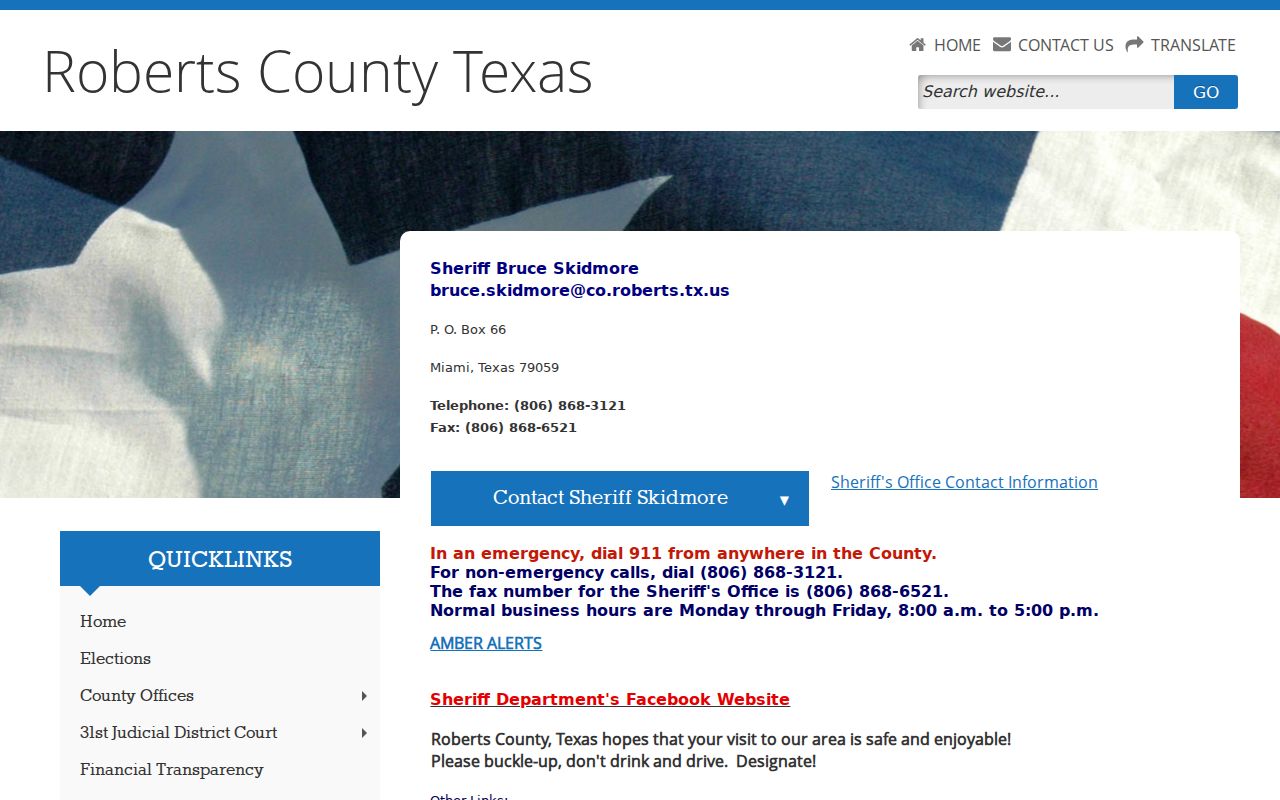
That office can identify the creating agency, possible booking number, and receiving facility, which are the keys to the next request.
Roberts County Sheriff's Office
P.O. Box 66
Miami, TX 79059
(806) 868-3121
Fax: (806) 868-6521
Monday through Friday, 8:00 a.m. to 5:00 p.m.
Looking Up Roberts County Arrests
Use full name and an approximate arrest date or time when calling. Ask for the receiving facility and booking identifier before asking broad questions. A very recent Roberts County arrest may not yet have a court cause number. Likewise, an outside jail roster can answer where a person is held without revealing the full incident report. Follow each record to the office that created or holds it.
- Call the Roberts County sheriff at (806) 868-3121. Ask whether the person is in custody, where the person was booked or transferred, and what identifier applies.
- Contact or search the confirmed receiving jail through its official channel. Do not assume that every Roberts County arrest goes to one neighboring county.
- Send a focused written request to the arresting agency for basic arrest, booking, or offense-report information. Send a separate custody request to the housing agency if needed.
- Call the County/District Clerk at (806) 868-2341 for any filed criminal cause. Check again later when the arrest is too recent for filing.
- Read the eventual court disposition, then use DPS for its public statewide subset or TDCJ and BOP for sentenced custody at the correct level.
Save the agency response and note the date checked. Reporting lag can make two official sources disagree for a time. The source record's custodian is the first place to seek a correction.
Roberts County Receiving-Jail Question
Roberts County has had extremely limited local capacity. A historical Texas Commission on Jail Standards report listed capacity as three and an average daily population of zero for that reporting period. Those figures do not prove current operations. A 2024 county treasurer report recorded a Hemphill County Sheriff inmate expense, which confirms that some outside boarding occurred. It does not prove that each Roberts County booking goes to Hemphill County.
Ask the Roberts County sheriff to name the actual receiving jail. Only then should the reader use that jail's roster, phone line, visitation rules, or release process. If Hemphill is confirmed, its official sheriff route may help, but its hours and rules apply solely to a person actually housed there. A correct neighboring-jail no-result can still answer the wrong question when the person was sent elsewhere.
Confirm the receiving facility before relying on any outside roster. Roberts County boarding evidence shows a possibility, not a standing destination rule.
Note: Current custody and the original Roberts County arrest report can be held by two different agencies.
Inside a Roberts County Arrest Record
No official Roberts County inmate profile is available for a verified local field sample. A focused request can still seek the common booking facts below, subject to the actual custodian's disclosure and redaction rules. The record may contain a booking image as an intake field, but no images or names of arrested people are republished here. A requester should ask only for the public information needed to understand the event.
| Booking number | Identifies the intake event and helps the sheriff or receiving jail locate the record. |
|---|---|
| Booking date and time | Shows when intake occurred, which may differ from the incident or release time. |
| Arresting agency | Names the office that created the arrest report and supplied the alleged basis for custody. |
| Charges and warrants | List intake allegations or warrant references that may change before prosecutors file a case. |
| Bond information | May state an amount, type, or court-set release condition. |
| Housing and release | May show the receiving facility, transfer, release date, and release reason. |
| Restricted fields | Medical, security, juvenile, victim, and confidential identifiers may be withheld or redacted. |
A booking entry proves that custody occurred. It does not prove that prosecutors filed the same charge or that a court found guilt.
Roberts County Booking Data Requests
The sheriff posts no official request form, fee schedule, records manager, or online tracker. A written request under the Texas Public Information Act should identify the existing record with care. State whether the request seeks an arrest sheet, booking log entry, incident report, warrant information, 911 or dispatch record, or available body-camera material. The electronic-evidence rules in Code of Criminal Procedure Chapter 18B do not create a general public report portal. Include the incident date, approximate time, location, agency number if known, desired format, and a reasonable date range.
| Request detail | Why it helps |
|---|---|
| Record type | Separates booking, incident, warrant, audio, and video records |
| Date, time, and location | Narrows a rural agency search |
| Case or booking number | Provides the best unique identifier when known |
| Name and date range | Helps locate the event without an identifier |
| Electronic or paper format | Clarifies the requested delivery method |
| Cost limit | Prompts an estimate before chargeable work exceeds the stated amount |
Government Code section 552.221 calls for prompt production. The familiar ten-business-day point concerns an agency's deadline to seek an Attorney General decision when it wants to withhold information; it is not a universal delivery promise. Active-law-enforcement material may fall within section 552.108, while protected identities and juvenile information can be redacted. Court filings should go to the clerk, not the sheriff.
Booking Logs and Recent Arrests
Roberts County publishes no official arrest blotter, current inmate roster, or online booking log. The complete fallback chain is a sheriff call, confirmation of the receiving jail, a written request to the arresting agency, and later review of any court cause. The lack of a web result says nothing about whether an arrest occurred. It reflects the county's access setup, not a finding about a person.
A roster, where a confirmed receiving jail offers one, normally focuses on current or recent custody. An entry may disappear after release or transfer. An arrest report may stay with the creating agency, while bond or housing facts sit with the jail. Filed charges and outcomes later sit with the Roberts County clerk. For final court details, Roberts County criminal court cases show what prosecutors filed and what the court decided.
Timing matters. If the clerk finds no cause shortly after a recent arrest, check again rather than calling it proof of no arrest. Prosecutor review can change, decline, replace, or enhance an intake charge.
Roberts County Custody System Changes
Local pretrial custody, sentenced state confinement, and federal imprisonment belong to different systems. The TDCJ Online Inmate Search covers Texas state custody, not Roberts County jail intake. It accepts a last and first name or direct TDCJ or SID number, with sex and race as optional filters. Typical results may show the state identifier, facility, offense, county of conviction, sentence, projected release, and parole information.
| TDCJ field | Type | Use |
|---|---|---|
| Last and first name | Text | Name-based search; spelling matters |
| TDCJ number | Text | Direct state identifier |
| SID number | Text | Alternate Texas identifier |
| Sex and race | Dropdowns | Optional filters for candidate results |
The official TDCJ interface makes the state-custody boundary visible.
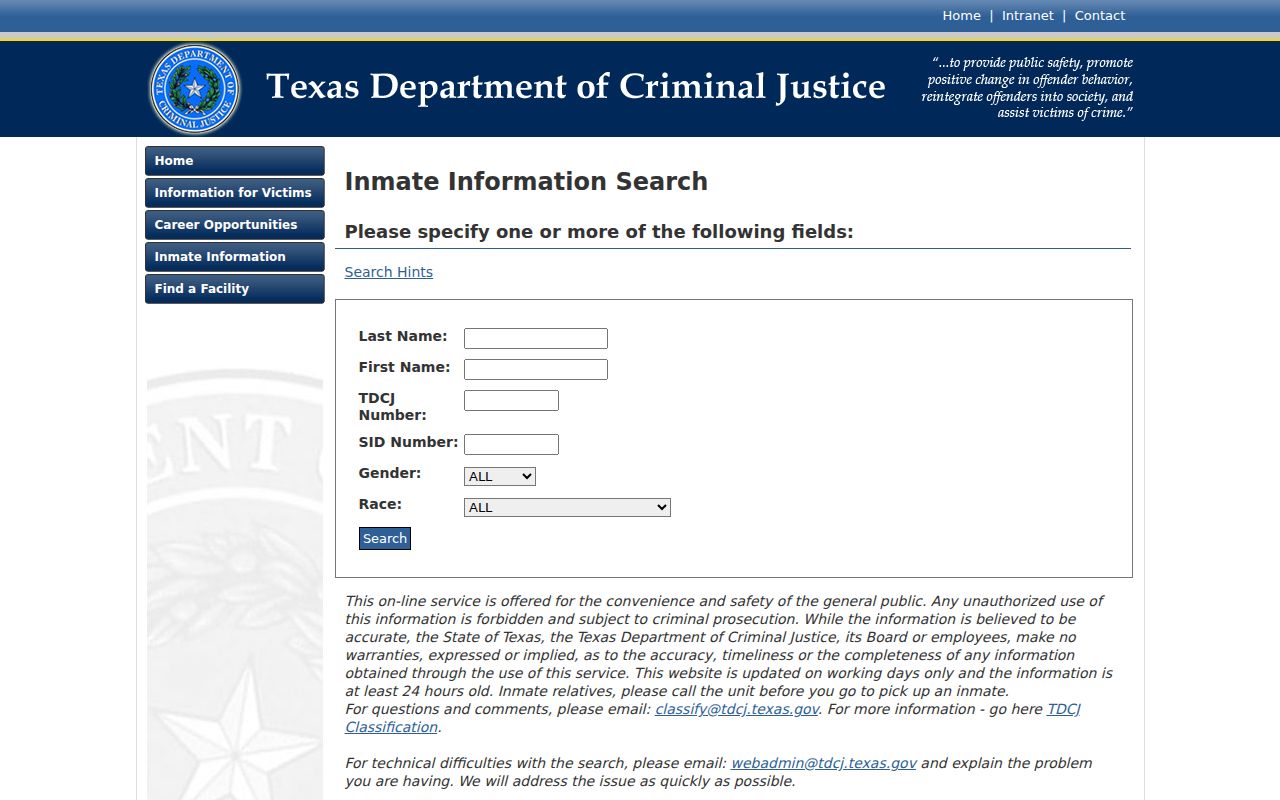
A TDCJ record reflects sentenced state custody and cannot replace a call about a new Roberts County booking. The official Texas VINELink explanation describes a supplementary custody and release notification channel, not a court disposition. Federal custody uses the Bureau of Prisons Inmate Locator, which searches by federal identifiers or name and demographic filters.
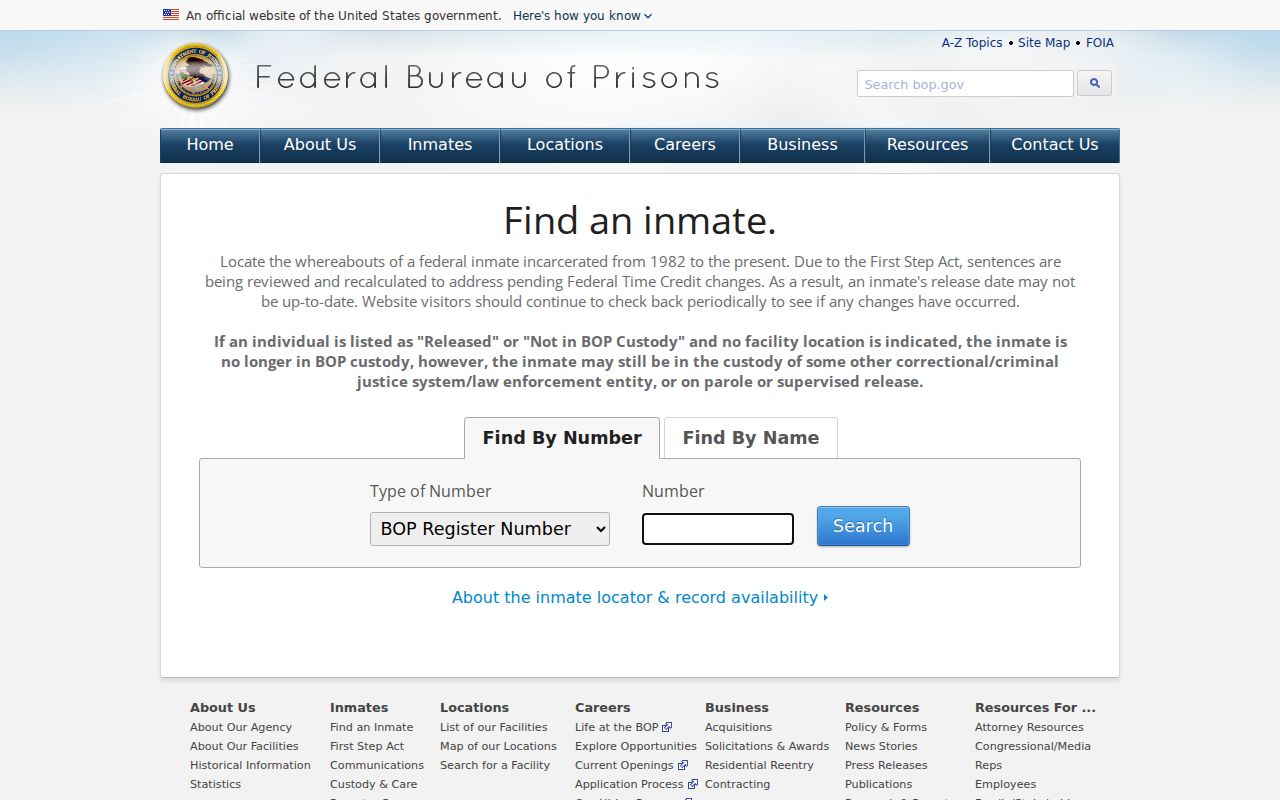
The federal locator is a later custody layer, not evidence of a local booking or a substitute for the Roberts County sheriff.
Roberts County Arrest Charges Can Change
An arrest charge records the alleged basis for custody at that stage. Prosecutors may decline it, file a different charge, change the degree, add an allegation, or present a felony matter to a grand jury. The court file then records the prosecution, plea, motions, disposition, and sentence. This is why a booking charge should never be copied into a claim about the outcome.
- Magistration
- The early proceeding for warnings, counsel information, and a bail decision after arrest.
- Arraignment
- The later court proceeding where the filed charge is read and a plea is taken.
- Disposition
- The court's result, such as dismissal, acquittal, deferred adjudication, or conviction.
- Bond
- Security or a promise supporting release and future court appearance.
Code of Criminal Procedure Chapter 15 governs arrest warrants and arrest procedure, while Chapter 17 addresses bail and bond. Article 15.17 calls for magistration without unnecessary delay and generally frames 48 hours as an outer period for presentation to a magistrate. It does not promise release within 48 hours. The filed case remains the source for what happened after booking.
Arrests Are Not Convictions
A Roberts County arrest record and a conviction record are created at different points by different custodians. The arresting agency and booking facility document custody. The clerk records filed allegations and the court's outcome. Texas reporting duties, including those collected in Code of Criminal Procedure Chapter 2, help move qualifying data into state systems. DPS shows public users only the statutory subset, mainly conviction information and qualifying deferred adjudications under Government Code section 411.135. A name search can also produce identity ambiguity or lag.
| Arrest record | Conviction record |
|---|---|
| Created by the arresting agency and booking facility | Created through the court case and reported disposition |
| Shows that custody and intake occurred | Shows a judgment or qualifying result that establishes guilt |
| Held by the sheriff, arresting agency, or receiving jail | Held by the clerk and reported to the state repository |
| May end in release, no filing, dismissal, or later prosecution | May include sentence, appeal, or later lawful record relief |
The comparison protects against a common error: reading an intake allegation as the end of a case. Use the Roberts County clerk's judgment or disposition to verify what the court decided. For the reader's own full Texas record, a fingerprint-based DPS personal review is more reliable than a public name match. The FBI Identity History Summary instructions describe the separate subject-only federal fingerprint route.
Note: A Roberts County arrest is not proof of guilt, and the filed charge may differ from the booking allegation.